.jpg)
It also painted a grim possibility of any major gains in the rupee during the current fiscal saying that the continuing global volatility, and domestic political uncertainty ahead of the 2014 hustings will limit chances of any significant appreciation apart from further impact growth.

Bangladesh is in turmoil, which is not good news for India, which shares a porous 4000 km border with it. There is a danger of fundamentalism growing there, and India has to move in to reset its ties with the new dispensation before China and Pakistan make capital out of it, alerts Ramesh Menon.
Domestic exporters on Monday expressed concerns over the crisis in Bangladesh and said the developments in the neighbouring country would have implications on bilateral trade. However, exporters expect that the situation may normalise soon. According to exporters, they are already facing disruptions in exports to Bangladesh due to a shortage of foreign exchange in that country.

Brent crude prices fell to $57 a barrel on Monday from $62 a barrel.

Dulat, however, pointedly said engagement with Pakistan has always been "influenced by domestic politics".

Bank of America (BofA) Securities expects India to be the third-largest economy in the world by 2031. The economic rise could become a reality by 2028, but the Covid pandemic delayed the pace, BofA Securities economists Indranil Sen Gupta and Aastha Gudwani wrote in a report.

'India's sizeable forex reserves should help stem a possible fall in our currency.'
The CAD was brought under control in 2013-14 after government imposed restrictions on import of gold. Following, this in 2014, certain restrictions were withdrawn.

If the market starts getting nervous about the political risk factor, currency depreciation could be a lot more severe and movement's jerky.

India spends significantly less on defence than could be expected from a country that faces simultaneous armed threats from two hostile neighbours -- China and Pakistan.
Foreign brokerage HSBC has said it expects the rupee to trade at 60-levels by December against the dollar even though risks on the domestic unit from both external and domestic fronts have increased.

Assume that the rupee will trend lower over the next 10 years as India increases overseas sovereign exposures, and your long-term asset allocation should be geared to deal with this trend, suggests Devangshu Datta

A weaker rupee could aid corporate earnings through its positive impact on export intensive sectors such as information technology services, pharmaceuticals and commodity producers such as metal and mining, and oil and gas companies.
Indian stocks and the rupee have benefitted from dollar liquidity induced by the US Fed stimulus.

Overall forex market sentiment suffered a sudden reversal of fortune contrary to expectation largely moving in line with local equities, reversing all early strong gains.

The rupee has posted its biggest single-day fall in more than four months to end at 62.95 against the dollar.

Gold reserve also declined by $340 million to $30.55 billion.
.jpg)
Chidambaram said recent measures taken by the Reserve Bank of India were aimed at reducing volatility in the financial market, where the rupee has dropped to record lows.

India's exports are unlikely to get an immediate boost from a depreciating rupee, which touched an all-time low on Monday, driven by rising commodity prices. The rupee fell to 76.97 against the dollar earlier in the day, settling 1.05 per cent weaker than the previous close. Oil prices soared to their highest since 2008 on Monday at $139 per barrel, after the US and European allies explored a Russian oil import ban, while delays in the potential return of Iranian crude oil to global markets increased supply fears.

The rupee had rebounded 15 paise to close at two-week high of 61.77 against the dollar at the Interbank Foreign Exchange on Friday.

Given the stability of the rupee over the last 10 months, many companies have been tempted not to hedge their foreign currency risk.

'When the gold price rises rapidly, India's physical gold market remains on standby.'

The Indian rupee, which has depreciated 1.1 per cent so far in August, is expected to decline further on the back of a strengthening US dollar and a weakening Chinese yuan, according to a Business Standard poll of analysts. The Indian rupee hit an all-time low recently, closing at 83.15 per dollar. Five of the 10 respondents said the Indian currency might touch 83.5 per dollar in August itself, while others said the worst could be over.

The rupee plunged 20 paise to close at an all-time low of 78.13 against the US dollar on Monday, as a lacklustre trend in domestic equities and stronger greenback overseas weighed on investor sentiments. Forex traders said weak Asian currencies and persistent foreign capital outflows were the other major factors that dragged the local unit down. At the interbank foreign exchange market, the local currency opened at 78.20 and witnessed an intra-day high of 78.02 and a low of 78.29 against the US dollar.

Global rating agency S&P on Tuesday said even though the US and the Euro zone are headed to recession, India is unlikely to face the impact given the "not so coupled" nature of its economy with the global economy. "Indian economy is a lot decoupled from the global economy than we normally think of, given its large domestic demand, even though you (India) are a net importer of energy. "But you have enough forex reserves on one hand and your companies have managed to maintain healthy balance sheets," Paul F Gruenwald, S&P global chief economist and managing director, told reporters in Mumbai.

Exchange-traded currency derivatives volumes are likely to drop in view of new Reserve Bank of India (RBI) rules, casting a cloud over further participation of retail investors and proprietary traders. There are concerns that existing positions without any underlying exposure will need to be liquidated. Also, weighed down by dollar demand from local oil companies and weakness in its Asian peers, the rupee on Wednesday (April 3) ended at a new closing low of 83.44 versus the US currency.

The benchmark Indian crude oil basket is now estimated to average $77.88 a barrel for FY19, compared to the government's earlier estimate of $65 a barrel for the year and $56.39 for FY18
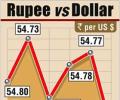
The Indian rupee dropped by 58 paise to a lifetime low of Rs 52.73 per US dollar in early trade on Tuesday on persistent demand for the American currency from banks and importers amid sustained foreign capital outflows from the equity market.

Economic growth has slipped to a six-year low of 5 per cent for the June quarter and is expected to turn in lower than that in the September quarter. Lack of consumption is seen as one of the key factors pulling down growth.
Rupee ended weak against the dollar.
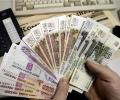
The rouble has been falling steadily since early November and collapsed earlier this month following a spectacular decline in the price of crude oil to five-year lows.

US brokerage Bank of America-Merrill Lynch on Tuesday said its sees the first rate cut this fiscal only in March next as inflation is expected to fall only by December end on a decline in commodity prices driven by the US Fed tapering.

The currency market won't care for our moans, groans, cries and sighs. The rupee will find its own level, explains Tamal Bandyopadhyay.

NPA issues in the banking sector, standoffs in Parliament denting the reform momentum and limited space on the fiscal side are among the major concerns for investors.

The current account deficit widened to $10.1 billion or 2.1 per cent of GDP for the September quarter as against 1.2 per cent in the year-ago period.

Tracking a recovery in local shares, the Indian rupee on Friday snapped a two-day declining trend and bounced back by 39 paise to end at 61.44 against the Greenback on fresh dollar selling by exporters and some banks.

The rupee is expected to become more jittery and choppy in the near-term
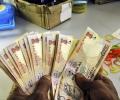
Weakness of dollar in the global markets and foreign capital outflows also affected the rupee sentiment.

Indian corporates might face higher borrowing cost in the overseas market in short-run due to the Greek debt crisis.
The rupee has depreciated 2.35 per cent in the past three months and one per cent in the past month, despite strong capital flows and falling oil prices.
